Can This Scientist’s Proposal Save Coral Reefs in Our Hemisphere?
Evolutionary expert Misha Matz makes a splash with a controversial proposal that could save Caribbean coral reefs.
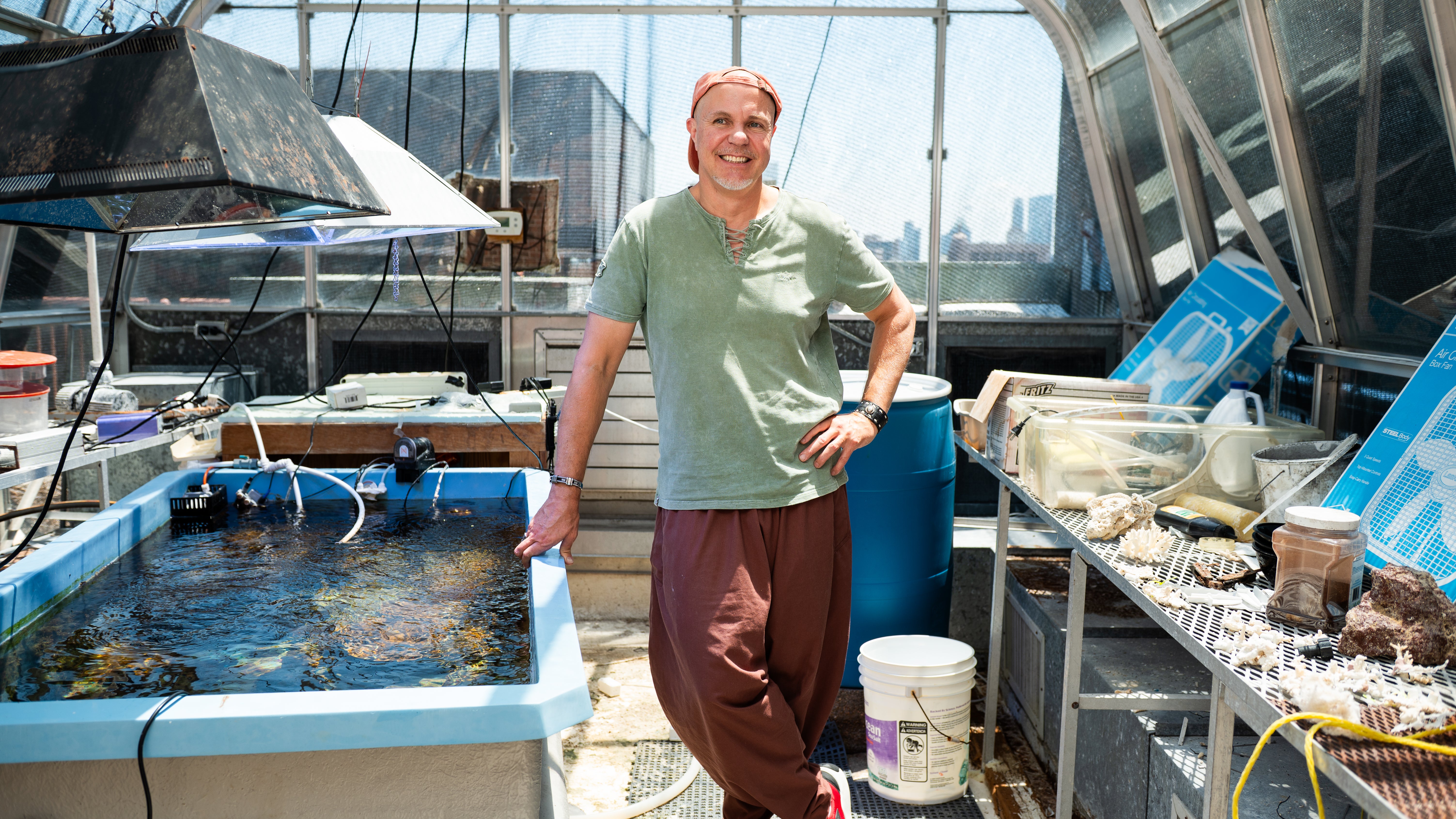
Misha Matz. Photo credit: Eileen Chong.
Despite only covering 1% of the global seafloor, coral reefs host more than 25% of marine species, making them the richest of the world’s biodiversity hotspots. Reefs around the world are experiencing a host of challenges, but in the Caribbean region they are especially threatened because the three main reef-building coral species are all showing signs that they can no longer reproduce. Meanwhile, restoration attempts in the Caribbean, which involve growing native corals in a lab and transplanting them back out onto the reef, have had mixed results. Now entire reef ecosystems are in danger of collapse at enormous potential consequence.
“If we lose the corals, we lose the fish and other species that live there. We lose a food source. We lose shoreline protection. We lose tourists,” said Misha Matz, a professor of integrative biology at The University of Texas at Austin. “In addition to a biological disaster, it would be a massive societal catastrophe.”
But as hope for those coral dims, Matz, an exuberant optimist, believes other coral might offer a solution. Earlier this year, he and two legal and ethics scholars published in Proceedings of the National Academy of Sciences a plan to transplant non-native corals from halfway around the world to the Caribbean. They in turn would help build a solid reef foundation and bring back an ecosystem at the brink. The basic idea was first proposed by James Briggs at Oregon State University in a journal article in 2009.
Rather than rescuing native corals, Matz and others are proposing “ecological replacement,” where hardier Indo-Pacific corals help stand in for vulnerable native ones. He admits this goes against a century-long tradition, where conservation biologists have worked only to restore or maintain the original state of any given system.
But, he said, it’s an idea whose time has come.
“As soon as you accept that the Caribbean reefs will never be like they were prior to 1980, that there is no way back, then it becomes a reasonable option,” he said.
Weighing ethics, policy and science, Matz and his fellow authors outlined how coral biologists, conservationists and regulatory agencies can move forward by beginning research on whether transplantation would be effective at shoring up the reefs and whether there would be any negative impacts to the rest of the ecosystem.
“I’m not by any means advocating for starting to plop corals between oceans right now,” Matz said. “What I am saying is: let’s start doing the research so that if we need this option, we’ll be ready to restore the ecosystem function and bring back the fish and bring back the tourists.”
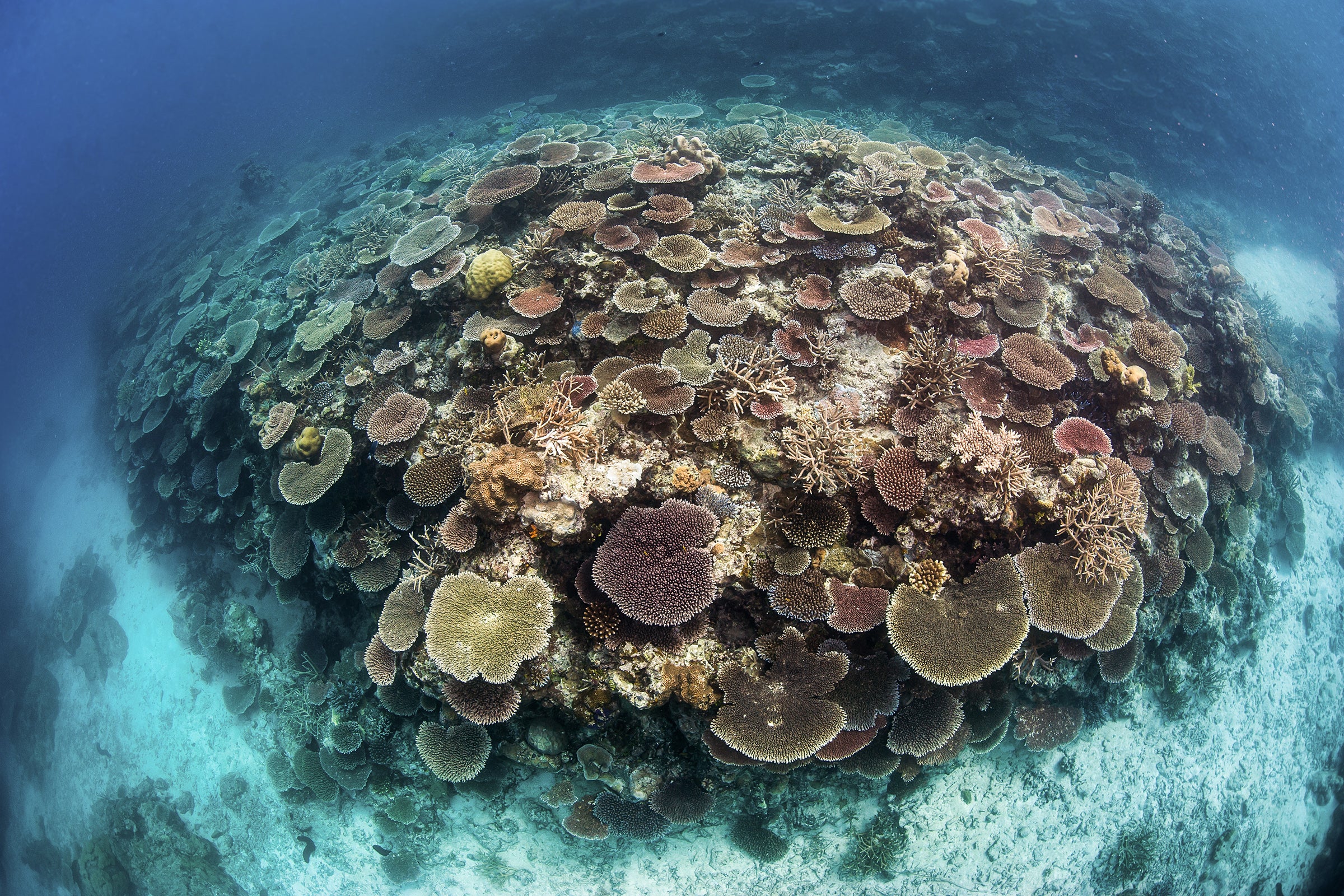
Could “super recruiter” corals—like these that sprung up in the western Pacific just several years after a typhoon destroyed the reef—help save Caribbean coral reefs? Photo of Acropora corals in Palau in 2018. Credit: Mark Priest.
A Project Hail Mary for Coral
It was 2021 when Matz, who had spent years studying the genetics of corals and exploring how to help them adapt to climate change, read an article that changed the trajectory of his research and prompted him to step out of his role as an academic and speak out publicly about environmental policy. The article, from George Roff, a coral biologist then at the University of Queensland, explained why the main reef-building corals in the Caribbean were quickly sliding into oblivion and taking the entire reef ecosystem with them: because they lost the ability to reproduce efficiently, making them extremely vulnerable to the kinds of stressors that are increasingly common in the Caribbean, from extreme storms to pathogens to pollution.
“This clinches it,” Matz thought. “Everything falls into place. That’s why the Caribbean reefs suffer so much compared to everywhere else.”
That insight inspired Matz to start to wonder about replacing native coral with ones that have more of a knack for recovering from disasters. The focus would be, not on preserving every single species, but saving an ecosystem by adding new, hardier species that can plug gaps in ecosystem function.
He first presented the idea at a biology conference in Seattle in 2024, knowing it would be controversial. In ecology, after all, a longstanding precautionary principle calls for avoiding any action that could potentially cause irreversible environmental harm. But some ecologists warmed to the idea.
Margaret Miller, an expert on reef ecosystems who previously worked for the National Oceanic and Atmospheric Administration (NOAA) in Florida for decades, has seen firsthand the unraveling of the reefs there. Every few years, a storm or disease outbreak or unusually hot summer would rip through the reef, decimating the hard, reef-building corals—especially elkhorn and staghorn corals that build the foundation upon which more delicate corals, sea urchins, crabs and fish thrive.
“Each time, the population would collapse,” said Miller, now the research director for SECORE International, a non-governmental organization developing methods for coral restoration. “And each time, we thought maybe the corals that survived would be better adapted to the changing environment and would persist and repopulate. But then 5 or 10 years later, they’d ratchet down again. And then 5 or 10 years after that, they’d ratchet down even more. In between these mass die offs, we saw more or less zero recovery.”
For millennia, Caribbean corals didn’t need to be very good at sexual reproduction to thrive. The environment was relatively stable. Corals could send a billion, low quality larvae out into the water and even if just one successfully landed and took hold, that kept the reef stable and healthy. Corals there evolved to capitalize on longevity and asexual propagation, preferring to spread slowly and locally, rather than making high quality larvae. But the past few decades have seen dramatic changes to the environment, as Roff noted in his paper. Consequently, Caribbean corals find themselves backed into an evolutionary corner.
“It used to be enough to have one viable offspring out of a billion,” Matz said. “But if the environment changes a little faster, that effectively becomes zero out of a billion.”
Meanwhile, in the Indo-Pacific, some reefs are surprisingly resilient, frequently bouncing back following big disruptions like heat waves or storms. There, distant relatives of the Caribbean elkhorn and staghorn corals have evolved to become “super recruiters,” producing high quality larvae that spread easily, take root and grow fast.
“The reef can get [figuratively] bulldozed, and you come back 10 years later and you can’t tell the difference,” Matz said. “Larvae come from surrounding areas, and everything grows back spectacularly.”
These super recruiters inspired Matz to dream of transplanting them to save Caribbean reef ecosystems from disappearing. He and others, including Miller, say at some point things become so bad that the risks of failing to try new things are simply too steep.
“When you get into these extreme conditions, the precautionary principle reverses itself,” Miller said. “The old version was: don’t meddle in nature, because many times when man’s meddled in nature it’s had disastrous outcomes. But when the environment is fundamentally changing and you have such big population declines and inbreeding becomes a problem, the precautionary principle looks different.”
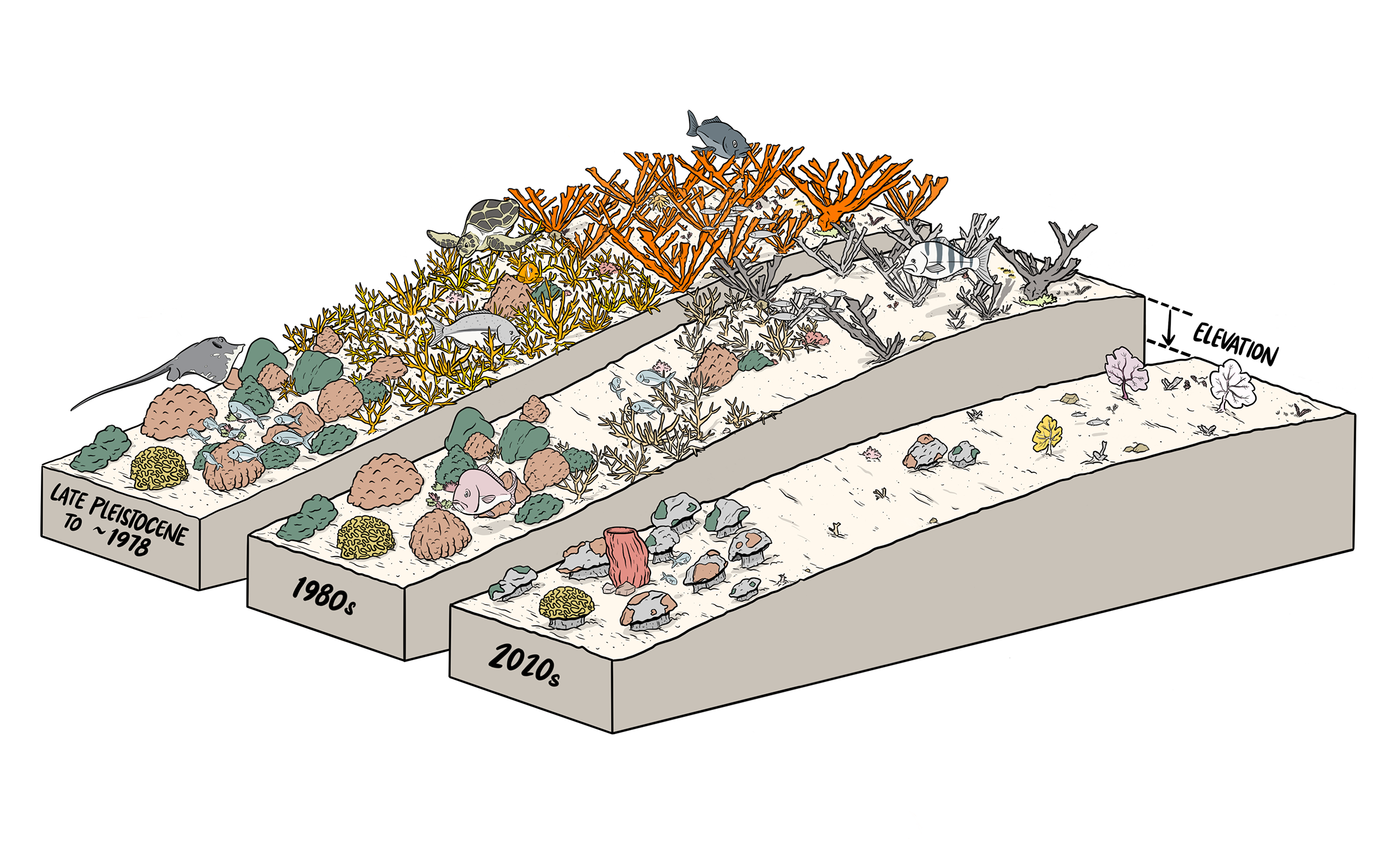
Recent changes in reef zonation of Caribbean/western Atlantic coral reefs, brought about by disappearance of elkhorn (orange) and staghorn (yellow) corals and lack of recruitment of massive boulder corals (Orbicella sp.). Without these key reef builders, the reefs have already measurably eroded. Illustration redrawn by Rashpal Dhilon (Rush Studio), based on a 2016 review paper in Conservation Biology by Kuffner and Toth.
Answering the Critics
Some biologists have raised concerns about Matz’s proposal. Apart from a general unease over making irreversible changes to an ecosystem, criticisms generally fall into two buckets: unintended consequences and potential for failure.
On the first count, there have been several high-profile examples of humans introducing a non-native species to solve one problem only for it to go on to wreak even bigger ecological havoc. Perhaps transplanted corals would bring along dangerous pathogens, directly harm organisms that depend on the coral or outcompete the native corals and hasten their demise—all outcomes Matz would find unacceptable.
He said, despite public perception, it’s rare for species introductions in the modern era to cause big negative consequences when research is carried out beforehand to understand potential impacts and mitigate against harms.
He pointed to a study looking at the impacts of over 1,000 species translocations (native and non-native) in the U.S. over more than a century. The authors found just one case where a conservation-focused translocation caused “damaging unintended consequences,” the accidental local extinction of a small fish in Alabama. Two other introductions—targeting mosquitoes and an agricultural pest—led to extinctions of native species. But the authors were careful to note that neither introduction was motivated by conservation, and both took place in the early and mid-20th Century, before modern conservation practices.
For safety, Matz said initial experiments with Indo-Pacific corals should be carried out in large tanks that replicate conditions in the Caribbean. Those experiments could include native corals and other associated reef organisms to shed light on interactions among species.
“We want the new corals to populate empty space, not oust the remaining few stands of native coral,” Matz said. “If these transplants are so competitive that they facilitate the extinction of the remaining natives, then that’s not going to work.”
And, if and when non-native corals are actually transplanted into the environment, to minimize the risk of introducing novel pathogens, they could first be reared from larvae in near-sterile conditions followed by quarantine in the large tank.
The second type of concern Matz often hears is that the effort might not work, for example, if the introduced corals have as much trouble in their new environment as the beleaguered native coral when it comes to the heat, pollution, sedimentation or diseases on this side of the world. Another key consideration is how microbial communities are different in each region. Coral species maintain critical relationships with algal symbionts that help them turn sunlight into energy. But it’s unclear whether Caribbean algal symbionts will be a good match for the transplants.
Matz notes that at least some Indo-Pacific corals are already able to survive in the Caribbean. Accidental introductions have happened in at least Jamaica and Venezuela, if not elsewhere. Regarding compatibility with local symbionts, he said scientists could put the foreign corals out temporarily on the reef to see which symbionts join them and then “yank them” before they spawn.
And even if research ultimately proves that ecological replacement is safe and effective, it wouldn’t be a silver bullet, as other actions will likely be needed for delicate coral reefs—including tackling climate change, diseases and pollution. And Miller continues to advocate for conventional coral restoration with native species to prevent the complete extinction of these ancient species. Nonetheless, she and others believe the world should at least be doing research on Matz’s ecological replacement proposal to see if it’s viable and undertaking serious evaluation of potential risks and benefits.
“I appreciate Misha and his colleagues raising this at the risk of the ire of the community,” she said.
Or as Matz puts it: “It’s an eleventh-hour solution, but I think it’s already 11:45.”
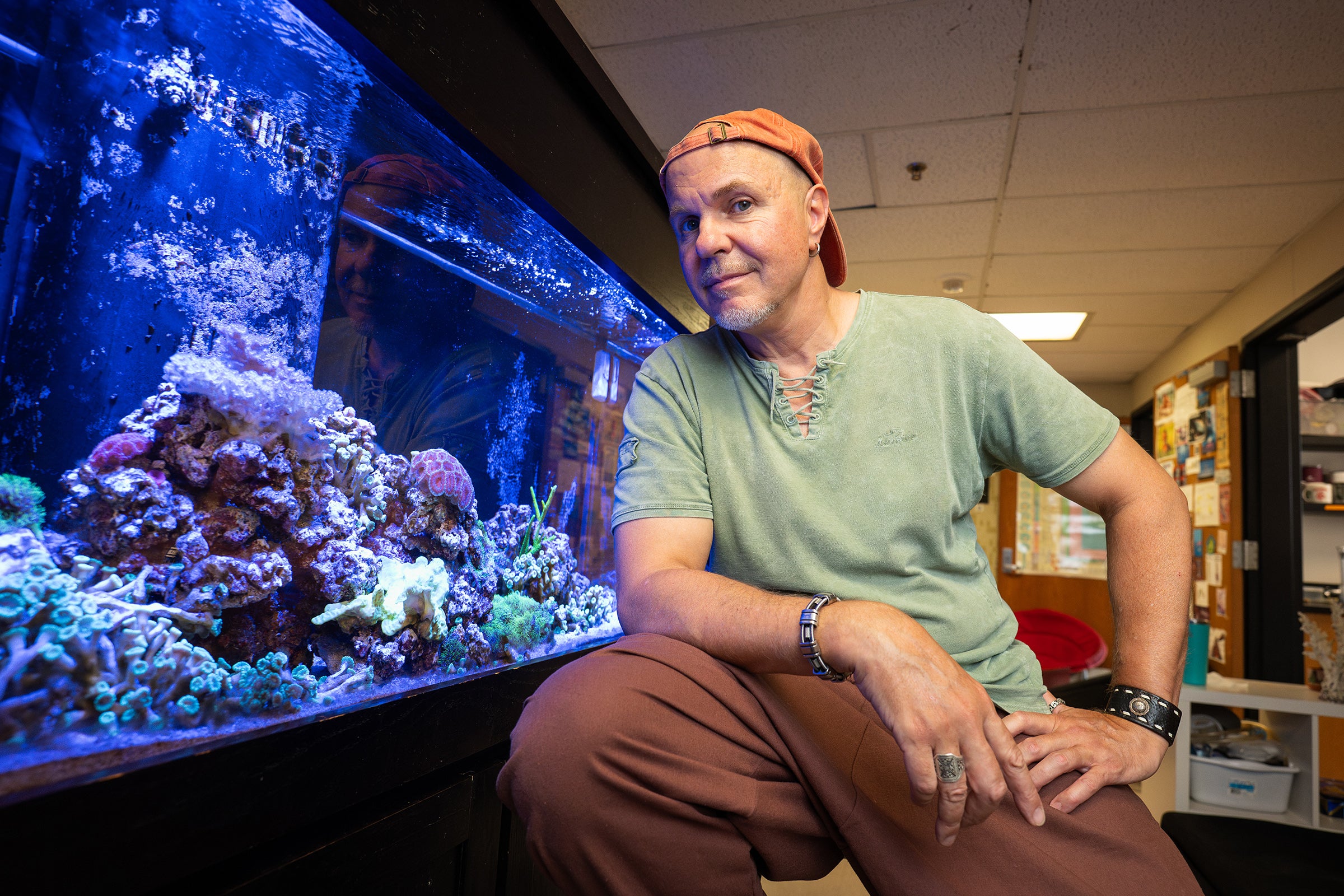
Misha Matz. Photo credit: Eileen Chong.